Your HVAC system depends on moving air efficiently through return ducts, filters, the air handler, heating or cooling components, and supply ducts before sending conditioned air back into each room. When parts of that system become heavily contaminated with dust and debris, airflow can become restricted, and important components may have to operate under less favorable conditions.
That is where air duct cleaning in NYC can be useful, but there is an important distinction. Cleaning relatively light household dust from duct walls does not automatically reduce energy bills. The U.S. Environmental Protection Agency says there is limited evidence that cleaning only the ducts increases HVAC efficiency. Research is more supportive when cleaning addresses dirty cooling coils, fans, heat exchangers, and other contaminated HVAC components along with significant duct contamination.
The potential efficiency benefit therefore depends on how dirty the system is, where the contamination has collected, and whether airflow or heat transfer is actually being affected.
How Air Moves Through Your HVAC System
Understanding the airflow path makes it easier to see how dirt can affect performance.
A typical forced-air system works roughly like this:
- Indoor air enters return grilles.
- Return ducts carry that air toward the HVAC unit.
- Air passes through a filter.
- The blower moves it across heating or cooling components.
- Conditioned air enters the supply ductwork.
- Supply registers distribute it throughout the building.
Each part of this path needs to remain reasonably clear.
If a filter is severely clogged, a cooling coil is coated with debris, or the blower has substantial buildup, the system can have more difficulty moving and conditioning the required volume of air.
Read More: What Happens if You Never Clean Your Air Ducts in NYC?
Airflow Is an Important Part of HVAC Performance
Heating and cooling equipment is designed to operate within specific airflow ranges.
Reduced airflow can affect how efficiently heat is transferred between the HVAC equipment and the air moving through it.
Possible sources of restriction include:
- Dirty filters
- Contaminated coils
- Dust-covered blower components
- Significant debris inside ducts
- Blocked registers
- Crushed or damaged ductwork
NADCA’s research on HVAC cleaning notes that dirty filters, clogged coils, fouled blowers, and other contaminated components can impede airflow. Its testing framework specifically looks at changes in cubic feet per minute, or CFM, before and after system cleaning.
That makes airflow one of the most useful concepts when discussing the relationship between cleanliness and HVAC efficiency.
Heavy Duct Contamination Can Restrict Air Movement
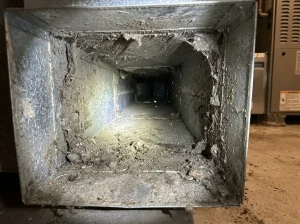
A thin layer of ordinary household dust on duct surfaces is different from substantial accumulation.
EPA guidance specifically identifies ducts that are clogged with excessive amounts of dust and debris as one of the situations in which cleaning may be considered.
Significant Debris May Include
- Construction dust
- Drywall particles
- Heavy lint
- Fibers
- Large dust deposits
- Renovation debris
- Pest-related material
When deposits become substantial enough to reduce the usable area inside the duct or collect around dampers, turns, grilles, and other components, airflow can be affected.
Not Every Dusty Vent Means the Ducts Are Restricted
This distinction is important.
Return grilles commonly become dusty because air is continually passing through them. EPA specifically notes that dusty return registers do not automatically mean the entire duct system contains heavy deposits.
A proper inspection should determine how far the contamination extends before cleaning is recommended for efficiency reasons.
Dirty Cooling Coils Can Have a Greater Impact Than Dusty Duct Walls
The cooling coil is one of the most important components in an air-conditioning system.
Warm return air passes across the cold coil. Heat is transferred from the air into the refrigerant system, allowing cooler air to return to the rooms.
When the coil becomes coated with dirt, that heat-transfer process can be affected.
Why Coil Cleanliness Matters
A dirty coil can create two problems at the same time:
- Air has more difficulty moving between the coil fins.
- Dirt can interfere with effective heat transfer.
EPA states that research suggests cleaning dirty cooling coils, fans, and heat exchangers can improve HVAC efficiency and may contribute to energy and maintenance savings. It is much more cautious about claiming the same result from duct-only cleaning.
This is why effective HVAC cleaning should look beyond the visible vents.
Blower Buildup Can Affect Air Delivery
The blower creates the airflow that carries heated or cooled air throughout the duct system.
If the blower wheel or fan blades accumulate significant debris, their ability to move air effectively can change.
Think of a clean fan blade versus one coated with a thick layer of material. The shape and weight of the blade are no longer exactly as designed.
Possible Signs of an Airflow Problem
You may notice:
- Weak airflow from several registers
- Rooms taking longer to reach temperature
- Uneven heating or cooling
- HVAC system running for long periods
- Noticeably dirty blower compartment
These symptoms are not proof that cleaning is required.
They can also result from:
- Closed dampers
- Duct leaks
- Incorrect equipment sizing
- Mechanical failure
- Dirty filters
- Damaged ductwork
Inspection should identify the actual source before cleaning begins.
What Research Says About HVAC Cleaning and Airflow
Available research suggests that heavily contaminated systems can show measurable airflow changes after cleaning.
An EPA pilot field study of residential heating and air-conditioning systems reported increases in airflow at supply registers and diffusers ranging from approximately 4% to 32% across eight homes after cleaning. In two homes with the largest increases in return airflow, estimated heat removal across the cooling coil increased by approximately 14% and 23%.
NADCA field testing has also reported airflow improvements after cleaning contaminated HVAC systems, although the organization cautions that results vary widely according to system condition and other variables.
These findings should not be interpreted as a promise that every home will see the same improvement.
A lightly dusty system may show little measurable difference.
Complete HVAC Cleaning Matters More Than Cleaning One Isolated Area
If the goal is improving a contaminated system’s performance, cleaning only one section can leave the rest of the airflow path unchanged.
EPA defines duct cleaning broadly to include components such as:
- Supply ducts
- Return ducts
- Registers
- Grilles
- Diffusers
- Cooling coils
- Heat exchangers
- Drain pans
- Fan motor and housing
- Air-handling-unit housing
The agency also warns that leaving one contaminated component untreated can contribute to recontamination of other parts.
Think of the HVAC System as One Connected Path
Cleaning the supply ducts while leaving a heavily contaminated blower or coil untouched may not address the main restriction.
Likewise, cleaning a coil while leaving substantial construction debris throughout the return system may leave another problem unresolved.
The inspection should guide the scope.
A Dirty Air Filter Can Cause Problems That Duct Cleaning Will Not Fix
Before assuming duct cleaning is the answer to weak airflow, inspect the filter.
A heavily loaded filter creates resistance to airflow.
EPA recommends:
- Using the highest-efficiency filter appropriate for the HVAC equipment
- Changing filters regularly
- Replacing them more frequently when they become visibly clogged
- Making sure air cannot bypass the filter through gaps around the holder
Changing a Filter Is Not the Same as Cleaning the Ducts
If the filter itself is the main restriction, changing it may solve much of the airflow problem.
If contamination has already reached:
- Coil
- Blower
- Plenum
- Duct system
additional cleaning may be appropriate.
This is why a basic HVAC inspection should come before automatically scheduling duct cleaning.
Renovation Dust Can Create an Efficiency Problem
NYC homes and commercial spaces undergo frequent renovation.
Drywall sanding, demolition, cutting, and construction work can produce large amounts of fine dust.
If supply and return registers remain open while the HVAC system runs, some of that material can enter the system.
EPA recommends sealing registers during dusty renovation work and not operating the heating and cooling system until construction dust has been cleaned up.
Post-Renovation Inspection Makes Sense When
- HVAC operated during demolition.
- Drywall was sanded indoors.
- Return vents remained uncovered.
- Construction debris is visible inside registers.
- Filters became heavily clogged.
- Airflow changed after renovation.
In these situations, the issue may go far beyond ordinary household dust.
Cleaner Components Can Support Better Heat Transfer
HVAC efficiency is not only about moving more air.
The system also has to transfer heat effectively.
During cooling, the evaporator coil removes heat from indoor air.
During heating, furnaces and heat pumps transfer heat into the airflow.
A contaminated heat-transfer surface can interfere with that process.
NADCA’s methodology for assessing HVAC cleaning examines both airflow and temperature change across the coil because those measurements together provide a better picture of system performance than airflow alone.
That is another reason why cleaning the complete contaminated system can be more meaningful than vacuuming only the visible duct openings.
Can Air Duct Cleaning Lower Your Energy Bill?
Possibly, but only under the right conditions.
If heavy contamination is restricting airflow or interfering with the blower and heat-transfer surfaces, restoring those components may help the HVAC system perform more effectively.
However, EPA specifically states that there is little evidence that cleaning only the ductwork produces meaningful efficiency gains in an otherwise properly functioning system.
Energy Use Depends on Many Other Factors
Your bill is also affected by:
- Outdoor temperature
- Thermostat settings
- Insulation
- Air leakage
- HVAC equipment condition
- Duct leakage
- Filter condition
- Equipment efficiency rating
- Building size
If energy bills suddenly increase, duct contamination should therefore be considered alongside these other possibilities.
Duct Leaks Are Different From Dirty Ducts
Air duct cleaning removes contamination.
It does not automatically repair air leaks.
A duct system with disconnected joints or poorly sealed connections can lose conditioned air before it reaches the intended rooms.
Cleaning those ducts will not close the openings.
You May Need Duct Repair or Sealing If
- Airflow is weak only in certain rooms.
- Duct connections are visibly separated.
- Conditioned air is leaking into an attic or other unconditioned area.
- Flexible ducts are crushed or damaged.
A complete HVAC evaluation should distinguish between cleanliness and physical duct problems.
How Do You Know Whether Cleaning May Help?
Look for multiple signs rather than scheduling cleaning based solely on system age.
Inspection Is Worth Considering When
- Heavy dust or debris is visible inside ducts.
- Debris is being released from supply registers.
- Blower components are visibly dirty.
- Cooling coil has significant contamination.
- HVAC system ran during major renovation.
- Airflow has declined.
- Filters become dirty unusually quickly.
- Pest contamination has occurred.
EPA recommends duct cleaning on an as-needed basis rather than according to a routine calendar.
That approach focuses the service on systems where there is something meaningful to remove.
What Should Happen After Cleaning?
Visual verification is one of the simplest ways to evaluate the result.
EPA recommends checking that:
- Duct interiors are visibly free of debris.
- Blower blades are clean.
- Blower compartment is clean.
- Cooling coil is visibly clean.
- Registers and grilles are clean.
- Access panels are properly sealed.
- HVAC system operates correctly after cleaning.
Before-and-after photographs can also document areas that are difficult for the homeowner to inspect directly.
Also Read: What Is Indoor Air Quality and Why Is It Often Worse Than Outside?
Keep the HVAC System Cleaner Afterward
Cleaning is more useful when the sources of contamination are controlled.
Good Preventive Habits Include
- Replace HVAC filters as required.
- Use the correct filter for the equipment.
- Prevent gaps around the filter rack.
- Keep supply and return registers open and unobstructed.
- Seal registers during dusty renovation.
- Have coils and drain pans inspected during HVAC maintenance.
- Control moisture problems.
If the source is not corrected, contamination can return.
Clean the System When Contamination Is Actually Affecting It
Air duct cleaning in NYC can support HVAC efficiency when substantial dirt and debris are restricting airflow or when contaminated system components such as cooling coils and blowers are interfering with normal performance. Research has shown measurable airflow and heat-transfer improvements in some heavily contaminated systems after cleaning, but EPA cautions that cleaning lightly dusty ductwork by itself has not been proven to improve efficiency.
At The NYC Air Duct Cleaning Co., we provide air duct and HVAC system cleaning for New York City properties where dust, renovation debris, and other contamination have accumulated inside the air-distribution system. We can inspect the accessible components first and determine whether cleaning is appropriate based on the actual condition of the ductwork and HVAC system.